


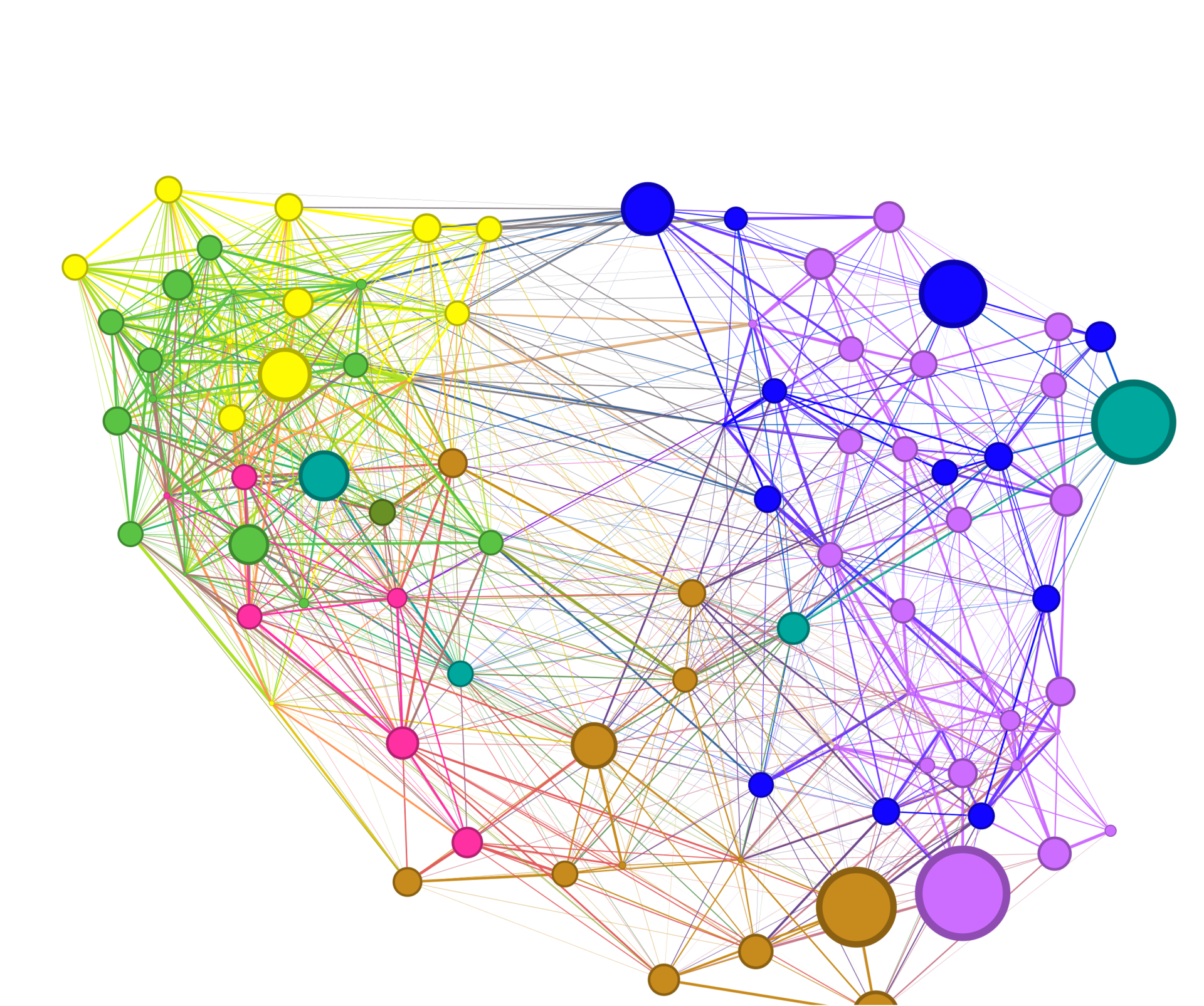
Skill-relatedness of industries and occupations
There are number of ways to show how economic activities are related to one another. A skill-relatedness network reveals the similarity between economic activities in terms of the workers’ skills they rely on, as workers are more likely to move between activities where they can still benefit from their accumulated skills and expertise.
Following the scientific literature (e.g., Neffke et al. 2017), we consider two economic activities – industries or occupations – as skill-related, if the observed labour flow between a pair (between occu_i and occu_j; ind_i and ind_j) exceeds what we would expect based on the propensity of these activities to experience labour flows.
To arrive at the final measure of skill-relatedness, we consider the average of the skill-relatedness in both directions – 𝑆𝑅𝑖𝑗 and 𝑆𝑅𝑗𝑖 –to receive a symmetric measure; we normalize the measure to have its range between -1 and +1; and keep only those links that are above 0, corresponding to above expected labour flows.
Attribution and use
We are making the dataset of our relatedness for both industries and occupations available for free below, under the Creative Commons Attribution 4.0 International (CC BY 4.0) license.
Users are free to share, use, and adapt the data for any purpose, including research, teaching, and commercial use, provided that appropriate attribution is given.
When using this dataset in academic work, we strongly encourage users to cite the following related publications:
- Rydgren, T., Hane-Weijman, E., & Eriksson, R. H. (2025): Navigating regional opportunity spaces: Labour branching towards growing jobs. European Urban and Regional Studies, 32(4): 399–420.
- Elekes, Z., Baranowska-Rataj, A., & Eriksson, R. H. (2023): Regional diversification and labour market upgrading: local access to skill-related high-income jobs helps workers escaping low-wage employment. Cambridge Journal of Regions, Economy and Society, 16(3): 417-430.
Users should also indicate if any modifications to the data have been made.
Data
Here you can find the normalized skill-relatedness tables for all pairs off industries (ind_i and ind_j) for all Swedish 3-digit industry codes (SNI07), corresponding to the NACE codes, between 2013-2019:
- Skill-relatedness matrix for industries (edgelist format).
- README file on industry skill relatedness matrix.
Here you can find the normalized skill-relatedness tables for all pairs off occupations (occu_i and occu_j) for the Swedish 4-digit occupation codes (SSYK) corresponding to the ISCO classification, between 2016-2019: